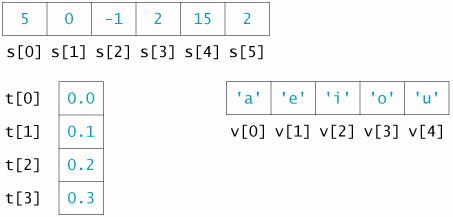
  int s[6]={5,0,-1,2,15,2};
  char v[5]={'a','e','i','o','u'};
  double t[4]={0.0,0.1,0.2,0.3};
If the initializing sequence is shorter than the array,
then the rest of the values are initialized to zero.
  int s[100]={1,2}; // same as {1,2,0,0,0....
  int z[100]={0};   // z initialized to all 0's
If an array is specified without a size, but with an initialization
sequence, the size is defined to be equal to the number of values in the
sequence.
  int s[]={5,0,-1,2,15,2};       // same as: int s[6]={5,0,-1,2,15,2};
  double t[]={0.0,0.1,0.2,0.3};  // same as: double t[4]={0.0,0.1,0.2,0.3};
Using a for loop to traverse an array:
int k;                 //  Declare variables
double g[21];
...
for (k=0; k<21; ++k)   //  Initialize the array g
  g[k] = k*0.5;
Again, using a function:
void init( double x[], int n) // Initialize an array
{
  int k;
  for (k=0; k<n; ++k)
    x[k] = k*0.5;
}
... in main:

  double g[21];

  init( g, 21);

  int M;

  // ... set M to some value ...

  double q[M]; // variable-size array, can not initialize with literal list, e.g. {1,2,3}

  init( q, M); // this works
#include <stdio.h>

void aprint( int a[], int n) // print an integer array of any size (using size n)
{
  for( int i = 0; i < n; ++i) printf( " %i", a[i]);

  putchar('\n');
}

void add6( int a[], int n) // add 6 to each element of an integer array
{
  for( int i = 0; i < n; ++i) a[i] += 6;
}

int main(void)
{
  int x[10]={0,1,2};  // x[0], x[1], ..., x[9]

  aprint( x, 10);

  for( int i = 0; i<10; ++i) x[i] = i;

  aprint( x, 10); // print all 10 values of x

  aprint( x, 5); // print first 5 values of x

  add6( x, 4); // add 6 to first 4 elements of x

  aprint( x, 10); // print all 10 values of x

  aprint( x+3, 5); // print 5 values of x starting with offset 3

  return 0;
}
Output:
 0 1 2 0 0 0 0 0 0 0
 0 1 2 3 4 5 6 7 8 9
 0 1 2 3 4
 6 7 8 9 4 5 6 7 8 9
 9 4 5 6 7
chapter5_2.c
/*-------------------------------------------------------------*/
/*  This function returns the maximum value in an array x      */
/*  with n elements.                                           */

double max(double x[],int n)
{
   /*  Declare variables.  */
   int k;
   double max_x;

   /*  Determine maximum value in the array.  */
   max_x = x[0];
   for (k=1; k<=n-1; k++)
      if (x[k] > max_x)
         max_x = x[k];

   /*  Return maximum value.  */
   return max_x;
}
Also see functions in chapter5_5.c